Optivexira
Path Framework
Path Framework
Couldn't load pickup availability
- 📁 Digital file available after purchase
- 🗂️ Long-term availability
- 🔒 Secure checkout
- 🗓️ Content updated in 2026
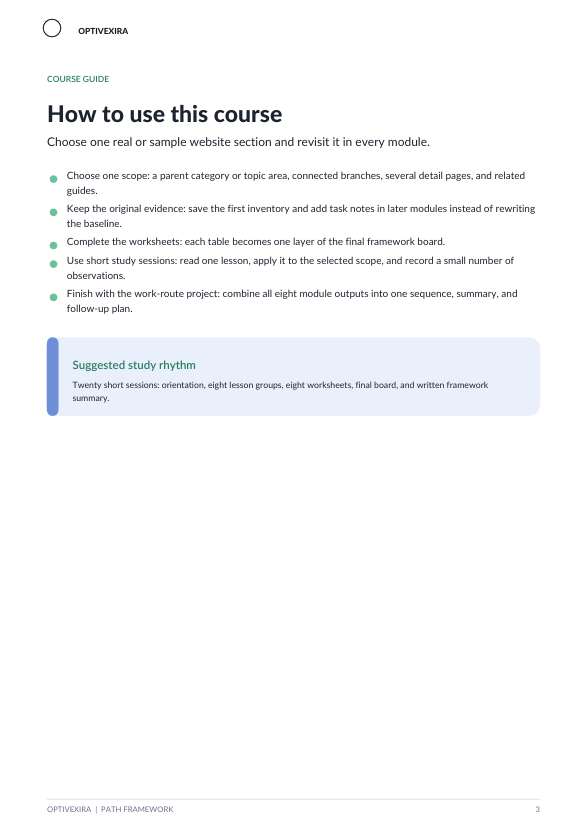
Self-paced learning overview
1. Problem Statement
After working with separate pages, it often becomes necessary to bring all observations into one working order. Without such a frame, SEO tasks may feel scattered: one page needs a clearer topic, another has weak navigation, and another repeats the content of a nearby section. In eCommerce, this is especially visible when categories, catalog item pages, informational pages, and filters exist without shared logic. Because of this, it becomes difficult to decide which part of the site to review first and how to connect content, structure, and technical observations. Path Framework is created to teach learners how to build an SEO route in a clear sequence.
2. Solution
Path Framework presents SEO as a set of connected stages, where every action has its place in the wider structure. The course shows how to complete an initial site review, group tasks by topic, and define the order of work with pages. You will learn how to create a frame for analysis: structure, search queries, content, internal links, eCommerce elements, and technical observations. The materials help turn scattered notes into a clear action list for further work. This plan is for learners who want to think not in isolated edits, but in a connected path for developing SEO structure.
3. What’s Inside
- Module 1: Path Entry Review — how to complete an initial site review and define the main areas for further analysis.
- Module 2: SEO Task Sorting — how to separate observations by direction: structure, content, navigation, and technical basics.
- Module 3: Page Path Mapping — how to create a route between main, supporting, and clarifying pages.
- Module 4: Query-to-Page Frame — how to connect search queries with specific pages without repeated topics.
- Module 5: eCommerce Flow Notes — how to review the user path between categories, catalog item pages, descriptions, and informational blocks.
- Module 6: Content Action Grid — how to record content tasks: clarify, expand, reduce, move, or merge.
- Module 7: Internal Navigation Plan — how to shape a scheme of internal links between related pages.
- Module 8: Framework Review Board — how to bring all observations into one table for further website work.
4. Who is this for?
✅ Good choice if you...
- already understand basic SEO ideas and want to work in a more organized way;
- have a website or eCommerce project with many pages, categories, or sections;
- want to learn how to organize SEO tasks by direction;
- work with content, structure, catalog pages, or navigation;
- are looking for a course that helps build a work sequence without loud claims.
❌ Not for you if...
- you are only beginning to explore SEO and are not ready to work with a site map yet;
- you expect an individual review of your project;
- you want a ready-made plan for all pages without your own analysis;
- you do not plan to work with tables, notes, or structure maps;
- you expect claims about specific metrics, rankings, or commercial outcomes.
5. What You’ll Learn
- Complete an initial SEO review of a website using clear criteria.
- Sort tasks by direction: structure, content, navigation, and technical basics.
- Create a route between different page types.
- Connect search queries with specific pages.
- Review the eCommerce path between categories, catalog item pages, and informational blocks.
- Build a list of content actions for pages.
- Plan internal links between related topics.
- Bring observations into a working table for further site review.
6. Purchase Terms
Path Framework is a paid Optivexira plan with materials for self-paced learning. Within 30 days after purchase, you may contact support about cancellation terms according to the rules shown on the checkout page. The course does not include claims about specific metrics, rankings, or commercial outcomes. The materials are intended for developing skills in structure analysis, organizing SEO tasks, and working carefully with websites and eCommerce pages.
7. Certificates & Credentials
After completing Path Framework, the learner receives an Optivexira certificate for studying SEO task planning, page routes, and content actions.
1. Are the courses suitable for beginners?
1. Are the courses suitable for beginners?
Yes, the materials are structured so users with different levels of experience can work with them. Topics move step by step from basic ideas to practical examples for websites and eCommerce. If you are new to SEO, it is better to begin with the entry plans. If you already have experience, you can choose a wider set of modules.
2. Can I study at my own pace?
2. Can I study at my own pace?
Yes, the materials can be reviewed in a rhythm that fits your schedule. Each plan has its own structure, so you can return to topics and review them again. This helps with understanding terms, page logic, content, and technical elements. The format works well for people who combine learning with work on their own website.
3. What kinds of projects are these courses for?
3. What kinds of projects are these courses for?
The courses are created for websites, blogs, catalogs, eCommerce pages, informational resources, and small online projects. The materials explain how to think about page structure, search queries, categories, descriptions, and internal site logic. You can use this knowledge for your own project or to better understand SEO processes. The topics are not tied to specific services or programs.
Share